

Why Are Off-Road Electric Go-Karts Popular for Private Property?
2026-09-20
If you own ten acres or more of private land, you have probably thought about getting a recreational vehicle. A side-by-side, an ATV, or a dirt bike are the traditional options. But a growing number of landowners are choosing something different: the Off-Road Electric Go-Kart. It is not a toy for children. It is a capable, quiet, and low-maintenance machine that can handle trails, fields, and gravel roads. The reasons for its popularity are practical: no fuel to store, no engine noise to disturb neighbors, and no complex drivetrain to maintain. This guide explains what makes these vehicles suitable for private property and what to look for when selecting one.
1. What Makes an Off-Road Electric Go-Kart Different From a Standard Go-Kart?
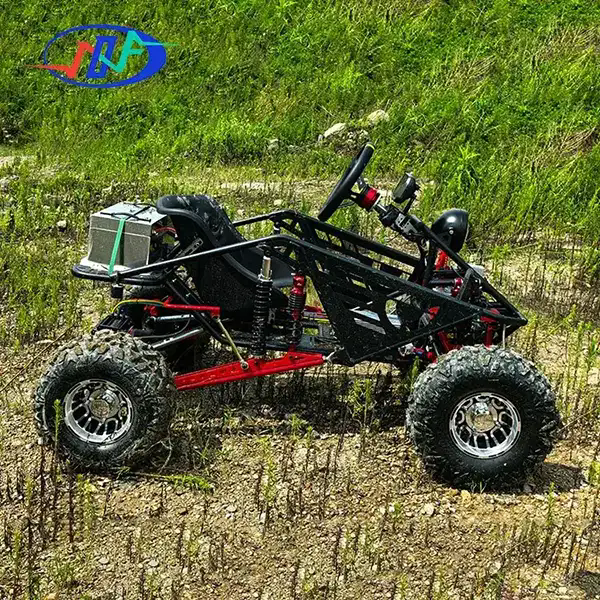
A standard go-kart is designed for a smooth, paved track. It has a low ground clearance, small tires, and a rigid frame. An Off-Road Electric Go-Kart is designed for unpaved surfaces. It has larger tires with aggressive treads, higher ground clearance, and a suspension system that absorbs bumps. The electric drivetrain provides instant torque, which is useful for climbing hills and pulling through mud or sand. In our factory, we build these vehicles with a reinforced steel frame and independent suspension on all four wheels. The battery pack is mounted low and centered to keep the center of gravity stable on side slopes. The table below shows the key differences between a standard go-kart and an off-road electric model.
| Feature | Standard go-kart | Off-Road Electric Go-Kart |
| Ground clearance | 50 – 80 mm | 150 – 250 mm |
| Tire type | Slick or semi-slick | Knobby or all-terrain |
| Suspension | None or rear only | Independent front and rear |
| Motor power | 1 – 3 kW | 3 – 10 kW |
| Battery voltage | 24 – 48 V | 48 – 72 V |
| Top speed | 30 – 50 km/h | 40 – 70 km/h |
Zhejiang Jindifan Technology Co., Ltd. manufactures Off-Road Electric Go-Kart units with these specifications. Our factory uses a 72V system with a brushless DC motor that delivers high torque at low speeds. This is important for climbing and for pulling loads.
2. Why Is the Quiet Operation a Major Advantage for Private Property?
Noise is one of the most common complaints about recreational vehicles on private land. A gasoline-powered ATV or dirt bike can produce 85 to 95 decibels, which is loud enough to disturb neighbors and wildlife. An Off-Road Electric Go-Kart produces only 60 to 70 decibels, which is comparable to a normal conversation. This quiet operation has three practical benefits. First, it allows you to use the vehicle early in the morning or late in the evening without disturbing anyone. Second, it does not scare livestock or wildlife, which is important if you use the vehicle on a farm or ranch. Third, it makes the driving experience more pleasant because you can hear the surroundings. In our factory, we have tested our electric go-karts in residential and agricultural settings. The feedback from landowners consistently highlights the quiet operation as a top benefit.
Common question: Can I use an electric go-kart on a farm for utility tasks like carrying tools or feed?
Answer: Yes, many landowners use their Off-Road Electric Go-Kart for light utility work. The instant torque and quiet operation make it suitable for moving small loads around a barnyard or field. However, it is not a replacement for a tractor or a utility vehicle for heavy loads. The payload capacity is typically 150 to 250 kg, including the driver. For light utility tasks, it is an efficient and low-cost alternative to a full-size UTV.
3. What Terrain Can These Vehicles Handle on Private Land?
The terrain capability of an Off-Road Electric Go-Kart depends on the motor power, the tire type, and the suspension travel. For flat fields and gravel roads, a 3 kW motor with all-terrain tires is sufficient. For hilly terrain with slopes up to 20 degrees, a 5 kW motor is recommended. For steep trails with rocks and roots, a 10 kW motor with a locking differential and high-travel suspension is required. The table below provides guidance on matching the vehicle to the terrain.
| Terrain type | Recommended motor power | Recommended tire type | Maximum slope |
| Flat field, gravel road | 3 kW | All-terrain | 10 degrees |
| Rolling hills, pasture | 5 kW | All-terrain | 20 degrees |
| Wooded trails, mud | 7 kW | Mud terrain | 25 degrees |
| Rocky slopes, steep inclines | 10 kW | Rock crawling | 30 degrees |
Zhejiang Jindifan Technology Co., Ltd. offers Off-Road Electric Go-Kart models with motor options ranging from 3 kW to 10 kW. Our factory can also customize the suspension and tires for specific terrain requirements. We recommend that customers test the vehicle on their own property before purchasing a fleet.
4. How Does the Cost of Ownership Compare to a Gasoline Vehicle?
The purchase price of an Off-Road Electric Go-Kart is typically comparable to a gasoline-powered ATV or side-by-side of similar capability. The difference is in the operating cost. Electricity is cheaper per kilometer than gasoline. A full charge costs $2 to $4, depending on local rates, and provides a range of 40 to 80 kilometers. A comparable gasoline vehicle would consume $8 to $12 of fuel for the same distance. Over a year of regular use, the savings can be $500 to $800. Maintenance costs are also lower. An electric drivetrain has fewer moving parts. There is no oil to change, no spark plugs to replace, and no air filter to clean. The brake pads last longer because regenerative braking reduces the load on the friction brakes. In our factory, we have tracked the maintenance costs of our electric go-karts over three years. The average annual maintenance cost is under $100, compared to $300 to $500 for a gasoline equivalent.
Common question: How long does the battery last, and how much does a replacement cost?
Answer: The battery pack in our Off-Road Electric Go-Kart is designed for 800 to 1,200 charge cycles. With normal use, that is 4 to 6 years of service. A replacement battery costs $600 to $1,200, depending on the capacity. The battery is a lithium iron phosphate (LiFePO4) type, which is safer and longer-lasting than the lithium-ion batteries used in some other vehicles. We also offer a battery upgrade option for customers who need a longer range.
5. What Should You Look for When Choosing a Model for Your Property?
When selecting an Off-Road Electric Go-Kart for private property, consider four factors. First, the size of your property. For less than 20 acres, a 3 kW model with a 40 km range is sufficient. For 20 to 100 acres, a 5 kW model with an 80 km range is better. For more than 100 acres, a 10 kW model with a 120 km range is recommended. Second, the terrain. If your property is hilly or wooded, choose a model with higher ground clearance and a locking differential. Third, the number of users. If you have a family, consider a two-seat model. Fourth, the charging infrastructure. You will need a 220V outlet near where you park the vehicle. Zhejiang Jindifan Technology Co., Ltd. can help you select the right model based on your property and usage.
Final Summary and Direct Call to Action
Off-Road Electric Go-Karts are popular for private property because they combine recreational fun with practical utility. They are quiet, low-maintenance, and cost less to operate than gasoline vehicles. They can handle a range of terrains, from flat fields to wooded trails. When selecting a model, match the motor power and range to your property size and terrain. Our factory has been manufacturing Off-Road Electric Go-Kart units for over 8 years and supplies to landowners and resorts worldwide.