Abstract:
Tracked scissor lifts have become a crucial solution in modern construction, maintenance, and industrial operations where stability, terrain adaptability, and safe elevation are required. Unlike traditional wheeled lifts, tracked systems are designed to operate on uneven, soft, or rugged ground conditions while maintaining superior balance and load capacity. This article explores how a tracked scissor lift works, its structural advantages, applications, safety considerations, and why brands like Foren are shaping the future of aerial work platforms.
Article Outline
This article is structured to help operators, procurement managers, and engineering teams understand tracked scissor lifts from both technical and operational perspectives:
-
Definition and structural overview of tracked scissor lifts
-
Mechanical and hydraulic working principles
-
Performance benefits in challenging terrains
-
Real-world industrial use cases
-
Safety frameworks and operational best practices
-
Maintenance cycles and longevity optimization
-
Procurement insights and product selection guidance
What is a Tracked Scissor Lift?
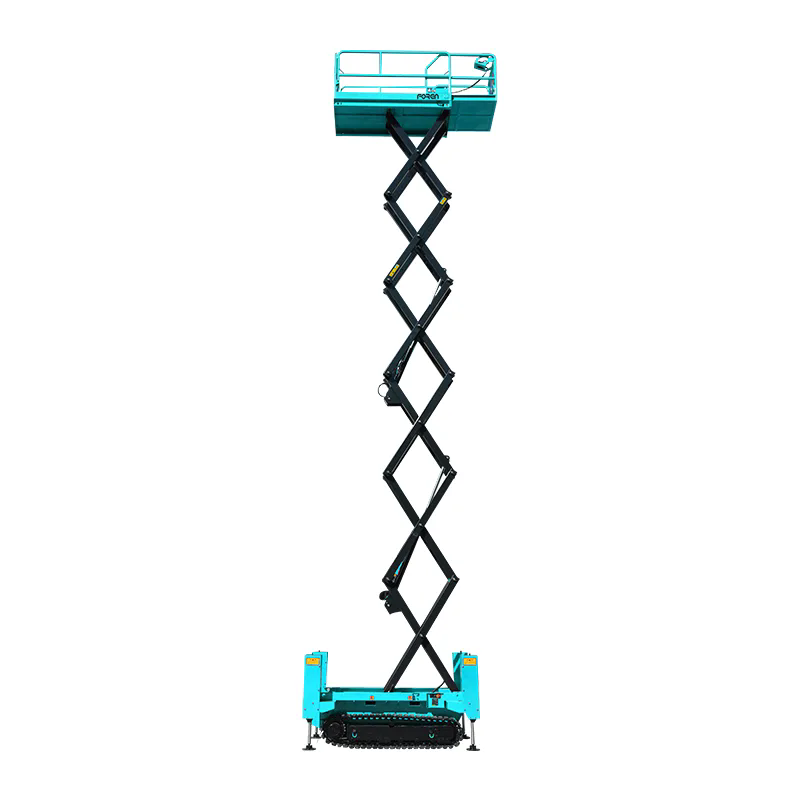
A tracked scissor lift is an aerial work platform equipped with a scissor mechanism mounted on a crawler track system instead of wheels. This design allows the machine to move efficiently across unstable, muddy, gravel-covered, or sloped surfaces while maintaining a stable lifting platform.
The integration of track propulsion significantly expands usability in environments where traditional lifts fail due to ground pressure limitations or traction issues. This makes it particularly valuable in construction sites, forestry operations, infrastructure maintenance, and outdoor industrial projects.
Core Components Explained
The efficiency of a tracked scissor lift depends on the synergy between its mechanical and hydraulic systems. Below are the key components:
-
Track System: Provides mobility and distributes weight evenly across surfaces.
-
Scissor Mechanism: A crisscrossing steel structure that extends vertically via hydraulic force.
-
Hydraulic Cylinder: Drives the lifting motion with precision and stability.
-
Platform Deck: The working surface for operators, tools, and materials.
-
Control System: Enables directional movement, lifting, lowering, and emergency control.
-
Power Unit: Typically diesel or electric-powered depending on the application.
Each component contributes to ensuring operational safety, load stability, and maneuverability in demanding environments.
How It Works
The working principle of a tracked scissor lift is based on hydraulic extension of crossed supports. When activated, hydraulic cylinders push the scissor arms upward, gradually elevating the platform in a controlled vertical motion.
The crawler tracks provide continuous ground contact, reducing surface pressure and preventing sinking in soft terrain. This ensures stable operation even during elevation or relocation.
Key operational phases include:
-
Power activation and system diagnostics
-
Track movement for positioning
-
Hydraulic pressurization
-
Vertical platform elevation
-
Load stabilization at height
Key Advantages
Tracked scissor lifts provide several operational advantages over conventional lifting systems:
-
Enhanced Terrain Adaptability: Operates on mud, sand, gravel, and slopes.
-
Low Ground Pressure: Tracks distribute weight evenly.
-
Improved Stability: Reduced tipping risk during elevation.
-
Higher Accessibility: Ideal for remote or unfinished job sites.
-
Increased Productivity: Faster deployment in challenging environments.
These advantages make them essential for industries requiring reliable vertical access without ground preparation costs.
Industrial Applications
Tracked scissor lifts are widely used across multiple industries due to their versatility:
-
Construction and building maintenance
-
Bridge inspection and repair
-
Warehouse and logistics operations
-
Outdoor event setup and lighting installation
-
Utility and power line maintenance
-
Forestry and agricultural infrastructure work
Their ability to operate in unpredictable environments makes them indispensable for field operations requiring height access.
Comparison with Wheeled Scissor Lifts
|
Feature
|
Tracked Scissor Lift
|
Wheeled Scissor Lift
|
|
Terrain Capability
|
Excellent on rough and soft ground
|
Best on flat, paved surfaces
|
|
Stability
|
High stability due to track distribution
|
Moderate stability
|
|
Mobility
|
Slower but more versatile
|
Faster on smooth terrain
|
|
Maintenance
|
Moderate complexity
|
Lower maintenance needs
|
|
Use Case
|
Outdoor, construction, rugged sites
|
Indoor, warehouses, factories
|
Safety Considerations
Safety is a critical aspect when operating tracked scissor lifts. Operators must follow strict protocols to minimize risk and ensure stable performance.
-
Always inspect hydraulic systems before operation
-
Ensure ground conditions are within load tolerance
-
Do not exceed platform weight capacity
-
Use harnesses when required by site regulations
-
Keep emergency descent systems functional
Proper training and certification significantly reduce operational hazards and improve efficiency.
Maintenance Guidelines
Routine maintenance ensures long-term reliability and reduces downtime:
-
Regular lubrication of scissor joints
-
Hydraulic fluid inspection and replacement
-
Track tension adjustment and wear checks
-
Electrical system diagnostics
-
Structural integrity inspections
Preventive maintenance not only extends equipment lifespan but also ensures operator safety in demanding environments.
Buying Guide and Foren Solutions
When selecting a tracked scissor lift, buyers should evaluate load capacity, platform height, terrain adaptability, and power system efficiency. Matching equipment specifications to operational requirements is essential for maximizing return on investment.
For professional-grade solutions, Foren offers advanced tracked scissor lift systems engineered for durability and performance in extreme conditions. Their designs focus on stability, ease of operation, and reduced maintenance downtime.
Conclusion
Tracked scissor lifts represent a significant advancement in aerial work technology, combining hydraulic lifting precision with crawler track mobility. Their ability to operate in challenging terrains makes them indispensable for modern construction and industrial applications.
By integrating safety, stability, and performance, these machines provide a reliable solution for vertical access challenges across industries. With innovative manufacturers like Foren leading development, businesses can expect continued improvements in efficiency and operational safety.
Foren is committed to delivering high-performance lifting solutions tailored to real-world challenges.
For more information or tailored solutions, contact us today to discuss your project requirements and discover how Foren can support your operations with advanced tracked scissor lift technology.